Ambrosia Symbiosis
  • Ambrosia Symbiosis
  • Beetles
    • Free Bark and Ambrosia Beetle Identification
    • Classification
    • Ecology
    • Diversity
    • Importance
    • Genetics and Sociality
    • Fungus Pockets
    • Fungus Stealing
    • Rearing Beetles
    • Catching Beetles
  • Fungi
    • Who Are the Fungi?
    • Genetics and Metabolism
    • Beetle-Fungus Interactions
  • Researchers
    • UF Forest Ent Lab members
      • Jiri Hulcr
      • Andrew Johnson
      • Benjamin Schwartz
      • Christopher Marais
      • Miranda Barnes
      • Daniel Kelley
      • Yiyi Dong
    • Collaborators
      • Tom Atkinson
      • Anthony Cognato
      • Seunghyun Lee
      • Andre Rodrigues
      • Peter Biedermann
      • Bjarte Jordal
      • Jason Smith
      • Sarah Smith
      • Synergy Semiochemicals
    • Alumni
      • A. Simon Ernstsons
      • Gabriel LeMay
      • Adam Black
      • Melanie Cabrera
      • Allan Gonzalez
      • Caroline Storer
      • Craig Bateman
      • Demian Gomez
      • James Skelton
      • João Araújo
      • Kirsten Prior
      • Morgan Hull
      • Martin Kostovcik
      • Rabern Simmons
      • Sawyer Adams
      • Sedonia Steininger
      • Surendra Neupane
      • Yin-Tse Huang
      • You Li
  • Resources
  • Media
  • Login
  • Blog
  • Lab Protocols

Articles posted by jirihulcr

New Means of Rearing Beetles in Lab a Success

Posted on July 17, 2019 by jirihulcr in Uncategorized
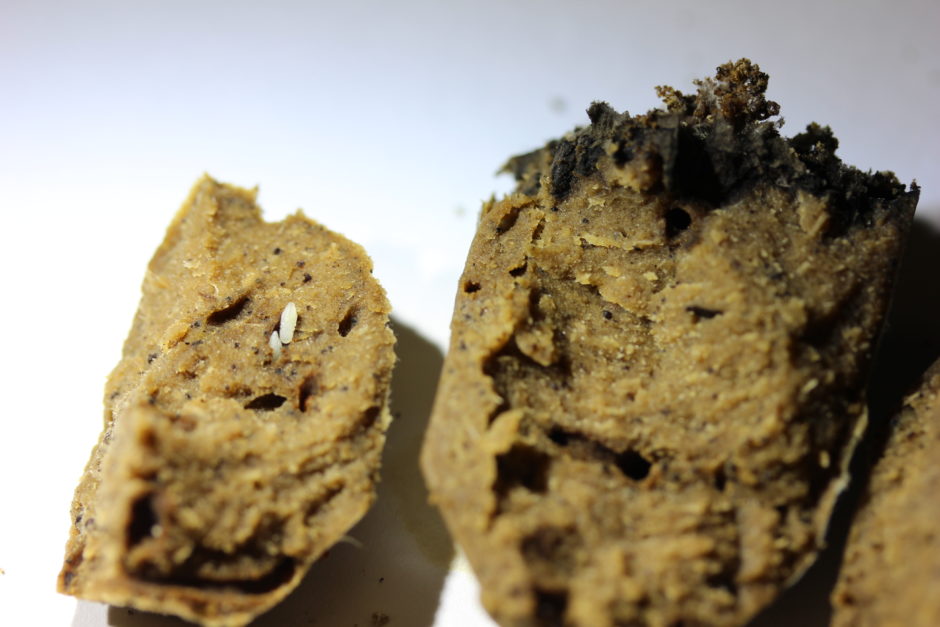
The Castrillo media fragments more easily than wood, allowing observation of galleries with minimal damage. Photo by Dr. Andrew Johnson.

If you want to study ambrosia beetles in a laboratory, you’ve got to have a way of not only keeping them alive but also encouraging them to thrive and reproduce. The simplest way of raising beetles in captivity has been to cut pieces of wood and place them in a jar with the beetles, effectively reproducing their wild habitat. But there are problems with this approach. The University of Florida’s Forest Entomology Lab has recently experimented with a new method that could become common.

The idea is to replace wood with a material that can be standardized, easily sterilized, customized to suit a particular experiment, and easily collect beetles from.

“Wood’s a little messy to deal with,” says Dr. James Skelton, a scientist involved in the lab’s experiment with a new method. “Opening it up, especially these xyloborus beetles that make extensive galleries, it’s hard to open that up without smashing the beetles inside.”

The new alternative involves mixing agar and sawdust with milk protein casein, wheat germ oil and a salt mixture. It forms a soft, wood-like substance that can be poured while hot into a vessel, where it solidifies.

The Carillo Lab at the University of Florida conducted experiments with this method for years, publishing a number of papers and establishing the model now being used by the UF Forest Entomology Lab. The Carillo Lab, in turn, was inspired by early experiments by Dr. Louela Castrillo of USDA.

Sawyer Adams, the Forest Entomology Lab’s manager, helped make the lab’s first batch of Castrillo media and will be producing it for the lab going forward. She says that the substance is simple to make.
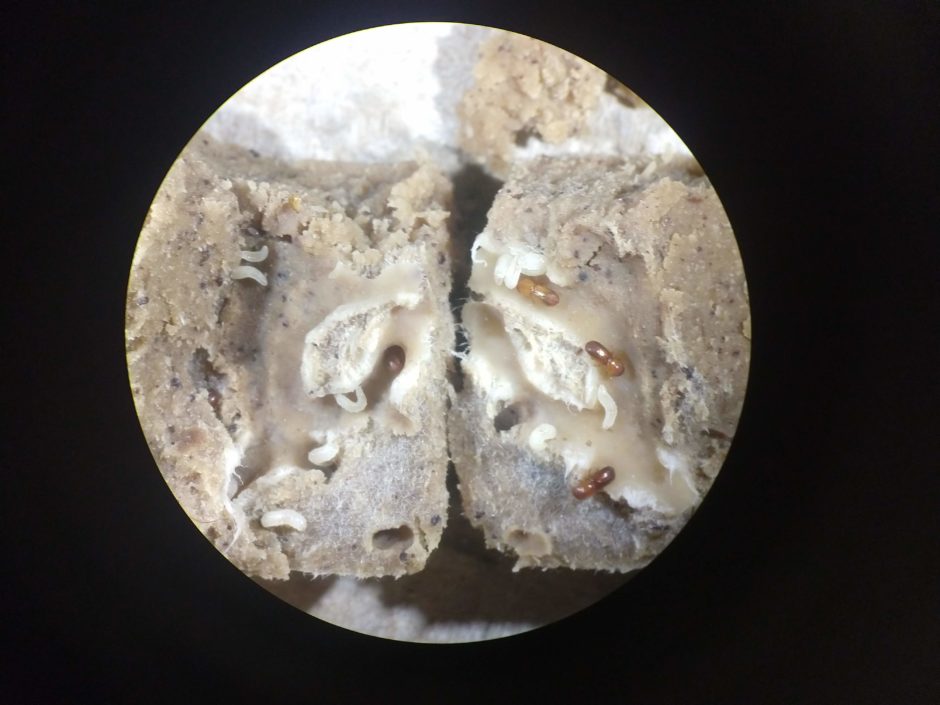
Photo by Dr. James Skelton

“Overall a takes few hours,” Adams says. “You mix it up, autoclave it, pour it, and then let it dry in the hood for week.”

Making a beetle media from agar and sawdust is nothing new — the lab has used that form of media for years as a sort of temporarily housing to keep beetles alive on plates during shipping. Few species thrived in it for long. The new addition of milk protein, wheat germ oil, salt and trace minerals takes a page from other areas of entomology where those substances are used to improve the nutrition of lab-reared insects. But it is something of a mystery as to how it is helping ambrosia beetles, which are thought to feed exclusively on fungus that they farm in their galleries.

“It seemed a little strange to me because the whole thing about ambrosia beetles is that they eat only their fungus,” says Dr. Skelton. “So why would you want to make a media that has a bunch of stuff in it that’s nutritious for beetles if they aren’t eating the media? It seems like you would want to make a media that’s good for fungus with malt extract or whatever. But for whatever reason this media works really well.”

It isn’t clear how or whether the added nutrition reaches the beetles. Are they eating the media directly, or are the nutrients mediated through the fungus? We don’t know yet.

The results from the Castrillo media impressed scientists at the UF Forest Entomology Lab very quickly.

“It’s easy and it’s fast,” says Skelton. “We’re producing dozens of progeny per initial beetle in a month. It’s like Drosophila, almost. The galleries looked nice and clean with tons of ambrosia growing in there. I think it could be a super powerful tool for testing hypotheses about what maintains particular relationships between certain fungi and certain beetles. Whether there is any adaptive value to beetles having multiple symbionts or one symbiont.”

Ambrosia beetles can be a powerful model for the study of evolution. With thousands of species radiating from multiple instances of convergent evolution, combined with their rapid rates of reproduction and close relationships to specific fungi and plants, ambrosia beetles allow scientists to test ideas about evolution far faster than is possible with mice and in more complex situations than using fruit flies.

“With this method, it’s easier [than with wood] to get everybody out,” says Dr. Skelton. “And presumably we can introduce all sorts of things to the media. Control the amount of nitrogen that’s available or phosphorus or carbon… whereas with wood it’s got what it’s got.”
Invent a term, win a prize

Posted on June 6, 2019 by jirihulcr in Uncategorized
Invent a term, win a prize

New Experiment to Study Introduced Wood Decay Fungi

Posted on May 30, 2019 by jirihulcr in Uncategorized
New Experiment to Study Introduced Wood Decay Fungi
Photo by Dr. James Skelton

The UF Forest Entomology Lab is embarking on a new set of experiments to better understand a recent pair of invaders that could potentially have an outsized impact on the environment. The ambrosia beetle Ambrosiodmus minor and its fungal symbiont Flavodon ambrosius are a pair of introduced species from Southeast Asia which are unusual because unlike most beetle-borne fungi, F. ambrosius is a wood-decaying fungus.

Among approximately 3,000 species of ambrosia beetles, which transport and cultivate specific fungi that serve as their sole source of food, only five are currently known to carry fungi that decay wood (though it is likely that there are more to be identified). Flavodon‘s ability to decay wood could have a broader effect in its introduced environment, impacting the forest microbiome.

“Flavodon offers an example of how [introduced beetles] might be kind of quietly changing ecosystem dynamics,” says Dr. James Skelton, part of the team researching the invasion, “introducing a fungus that is breaking down wood, getting there faster than other decay fungi, perhaps competing with native fungi and excluding native biodiversity.”

“Flavodon seems to out-compete other decay fungi,” says Demian Gomez, a PhD candidate leading the new study. “This fungus can grow really fast and outpace the other decay fungi.”

The first specimens of A. minor and Flavodon in North America were found in Jacksonville, Florida in 2011. Since then, the symbionts and their hosts have spread rapidly and become one of the most common species of ambrosia beetles in Northern Florida. They have also been collected in Georgia, Alabama and Mississippi. Analysis of their native range in Asia suggests that the beetles and fungi will probably be able to tolerate cold weather well enough to continue moving north into the forests of the mid-Atlantic.

A. minor can colonize many species of tree and is not specific to any particular clade of host plants. Even pine trees, with their unique set of chemical defenses, can be colonized. However, the beetles have not yet been observed attacking healthy trees. They target dead and dying hosts.

Photo by Dr. James Skelton

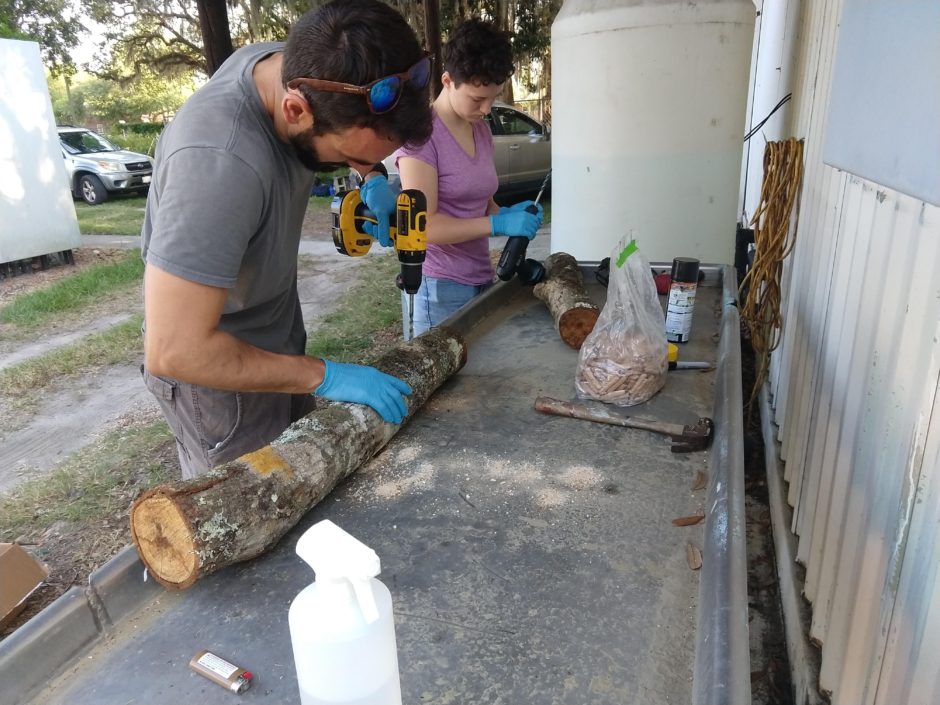
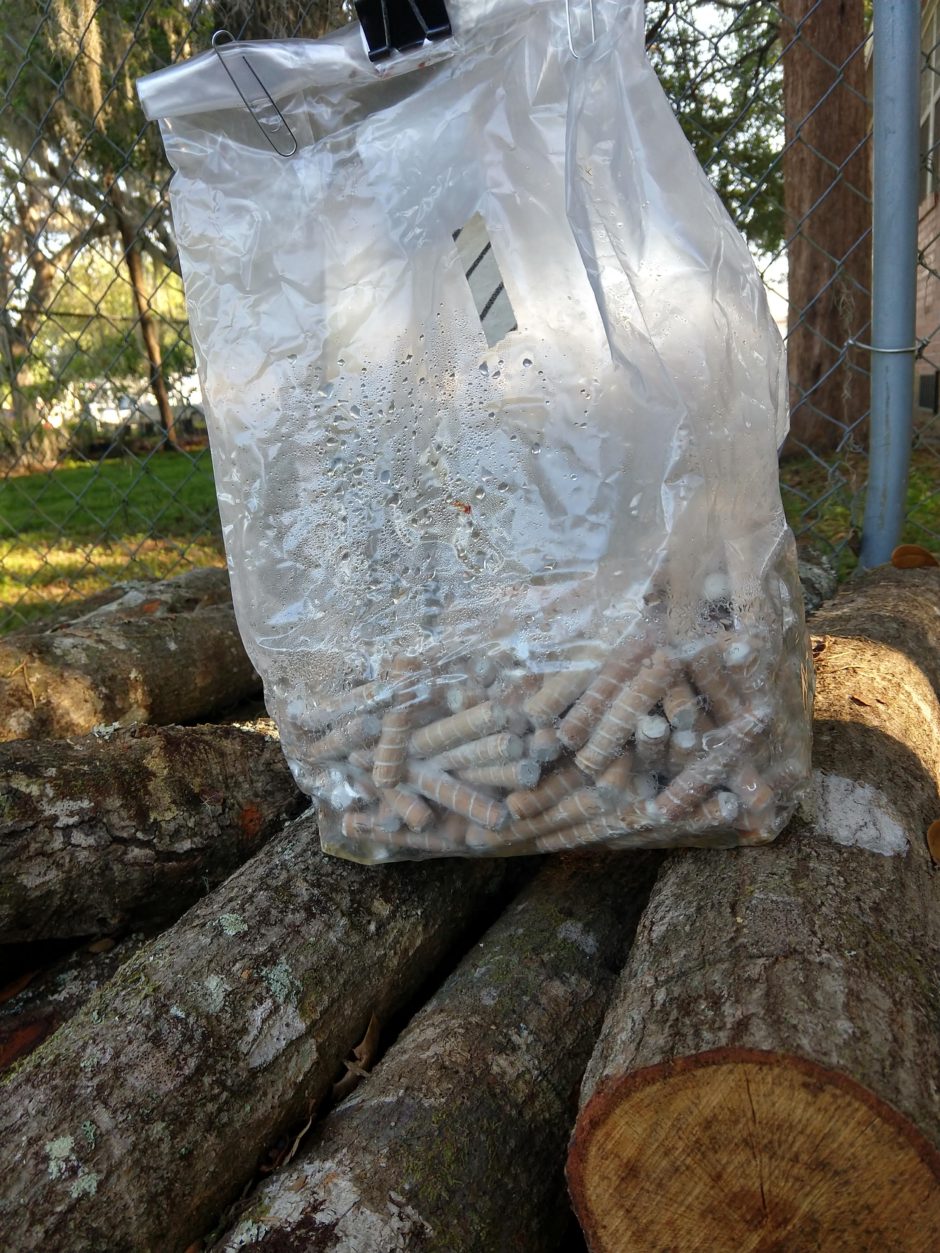
The experiment beginning this month involves inoculating 21 wooden logs with Flavodon. A control group of 21 identical logs were not inoculated. Innoculation was accomplished by drilling out a dozen holes in each log and filling them with wooden pegs pre-colonized in the lab with Flavodon. The control group received sterilized wooden pegs. The logs will be left in a forest for approximately seven months and then sampled to determine the composition of their respective fungal communities.

“We’ve seen that Flavodon is pretty aggressive,” Gomez says. “We’re going to test how it actually effects the natural communities of fungus. We want to quantify exactly how aggressive it is competing against other species in the fungal community.”

“These beetles are very abundant, they’re infesting a lot of trees and they are bringing in a novel fungus that is capable of doing pretty extensive decay,” says Skelton. “And that entry into the wood that Flavodon has is pretty unique among decay fungus. Most of them have to get in through wind blown spores, or wait for a limb to break… but having a beetle to fly you around and bore a hole through the bark and innoculate that fungus into freshly dead wood is an advantage that pretty much no other decay fungus has.”

“We might see increased decomposition rates and consequently more carbon released as CO2 as the wood decomposes,” Skelton says.

Sentinel Garden Project Set to Start in China

Posted on May 8, 2019 by jirihulcr in Uncategorized
Photo by Allan Gonzalez

With the coming of summer, the UF Forest Entomology Lab has two big things to look forward to. An increase in observable beetle activity, and the opportunity to step away from the classroom and lab to find out what’s happening in the field.

PhD candidate A. Simon Ernstsons will spend three months organizing field work in China that is critical to the future of the lab and for establishing a better way of preventing destructive outbreaks of forest pests. Ernstsons will be spearheading the lab’s new sentinel garden project aimed at identifying future pests before they even arrive in the US.

Ernstsons must find his way around several regions of rural China, obtain hundreds of trees of American commodity species that are rare in Asia, transport them to remote planting sites, then monitor them for damage by local insects. Some of the trees will be deliberately stressed to simulate the effects of flooding and drought.

“Then we have a really important data point where we know something potentially dangerous is in a certain area,” Ernstsons says. “We can then feed back that information back to USDA [division of Animal and Plant Health Inspection Service] and it can influence things like bio-security measures, phytosanitary control, that sort of thing.”

Sentinel gardens are a relatively new concept already being explored between France and China by Dr. Alain Roques and his team at the French National Institute for Agricultural Research. There is currently no equivalent involving the United States, though botanical gardens may notify one another when they notice a new pest on an exotic tree.

Organizing an experiment like this is not an easy task. Layers of government bureaucracy, cultural differences, and language barriers make it difficult to design and monitor an experiment involving hundreds of trees that are scarce in China. Fortunately, Ernstsons (who speaks five languages, including Mandarin), has experience with a small-scale pilot project for the lab last summer.

“Imagine trying to arrange two hundred trees to be delivered to a village on the side of a mountain in the middle of rural China, how would you go about doing that and how difficult do you think would that be?” Ernstsons asks. “That’s my experience. Going out and doing those kinds of things with local scientific collaborators, but also collaborators for logistics, things like sourcing and buying the trees.”

The work is funded by grants from USDA’s APHIS through the Plant Protection Act, section 7721.

As invasive beetles including the emerald ashborer and the Asian long-horned beetle continue to destroy American trees, could those infestations have been prevented by sentinel gardens? Ernstsons believes so.

“We certainly could have known well in advance and tried to put measures in place. Once it’s arrived we’ve seen again and again that ninety nine percent of the time it’s a losing battle.”

New Lab Manager at the UF Forest Entomology Lab

Posted on April 12, 2019 by jirihulcr in Uncategorized

Sawyer Adams, left, with Allan Gonzalez, right. Photo by Jackson Landers.

The Hulcr Lab now has a new lab manager.

Allan Gonzalez, our talented out-going manager, is moving to South Africa to begin graduate work at the University of Pretoria.

With a background in community ecology before joining the Hulcr Lab, Gonzalez intends to use his new ambrosia beetle expertise to study the polyphagous shot hole borer (Euwallacea whitfordiodendrus) and the fungus associated with it. An outbreak of the invasive beetle has exploded across South Africa and has devastated urban vegetation in many cities.

“I want to see how it’s impacting native trees in the Eastern Cape of South Africa,” Gonzalez says.

In addition to his duties managing the lab, Gonzalez also contributed to several papers as a co-author and spearheaded research for a pest management company.

The lab welcomes our new manager, Sawyer Adams, who will graduate from the University of Florida this spring with a botany degree. She began work at the Hulcr Lab in March in order to begin a transition alongside Gonzalez. Adams brings a new type of expertise into the lab as our only botanist.

PhD Student Position 2019

Posted on April 9, 2019 by jirihulcr in Uncategorized
PhD Student Position 2019

Forest symbiology: interactions between bark beetles, fungi, trees and the planet

PDF HERE: PhD student position

Join the Forest Entomology team at the University of Florida (www.ambrosiasymbiosis.org) on our quest to understand bark beetles and their impact, and communicate your science to various audiences. We are looking for someone to train with us while bringing new ideas, skills, or even a new discipline to this team.

Our team includes expertise ranging from molecular ecology to biosystematics to invasive species and climate change. You could be an entomologist, mycologist, or molecular biologist but you don’t have to be. You could just as easily be a computer scientist or an economist interested in forests, symbioses or the environment. We are interested in self-motivated, hard-working young scientists who will collaborate with the rest of the team on cutting-edge questions and exciting publications.

Do you have these TALENTS?

  • Self-sufficiency in the field
  • Quantitative thinking
  • Scientific writing

These skills are not required but represent some of the types of fields that you may train in as a member of our team:

  • Ecological statistics
  • Molecular biosystematics
  • Entomology, mycology or phytopathology
  • Experience with government agencies or with the cooperative extension
  • Computer programming
  • Database management
  • Documentary techniques, such as video, creative writing, or online science communication

Your salary, tuition, health care and research expenses will be fully covered. We welcome and encourage women, minorities, and LBGTQ candidates to apply. As part of the funding (graduate assistantship) you will be expected to contribute to extension activities or teaching.

Dates

Applications are due on January 10, 2019. Your appointment would start in the fall of 2019.

Location

  1. The main campus of the University of Florida in Gainesville, FL, one of the best college towns in the US.
  2. Various field locations in Asia, South Africa, Central America, etc.

How to apply

Email 1) your CV with emphasis on publications, 2) a short statement of interest and 3) a list of your hobbies to hulcr@ufl.edu with subject line “PhD applicant 2019”.

Hulcr Lab is Looking for Talent

Posted on March 13, 2019 by jirihulcr in Uncategorized
Hulcr Lab is Looking for Talent

Join the the University of Florida Forest Entomology lab in the exploration of the relationships between beetles, fungi, trees and people. Our research ranges from systematics and evolutionary biology to applied research on invasive species.

PhD graduate assistantship 2020-2024

The fully-funded PhD student position includes a $24,000 annual stipend, tuition, health insurance, research expenses, and visa assistance (the total value of this position is over $200,000). Opportunities for international travel, conference visits and collaborations will be regularly available. International students are encouraged to apply.

Our lab offers diverse career directions for PhD students. Potential research topics include:

  • fundamental research: symbioses, molecular systematics of beetles or fungi, invasion ecology
  • forest health: pest and disease diagnostic tools, invasive species assessment, forest pests in Asia (particularly China)
  • government or extension: strategic communication, forest resource policy

While we appreciate previous experience with entomology or mycology, it is not a problem if you don’t have any. What we value even more is commitment to rigorous science and a career related to modern biology or forest resources.

Postdoc or short-term visiting scholar 2020 and beyond

The fully-funded postdoctoral associate position includes a $50,000 annual stipend, health insurance, research expenses, and visa assistance. The duration of the contract is one year with high likelihood of extension to multiple years depending on productivity. Access to cutting-edge research technology and opportunities for conference visits and collaborations are regularly available. International applications are welcome.

The postdoctoral scholar is expected to focus on a topic related to the relationship between bark/ambrosia beetles and fungi, ideally using molecular biology methods. Previous experience with beetle research is not necessary, but modern molecular biology experience is a bonus. Topics that we are seeking to develop include:
– Molecular and traditional systematics of ambrosia fungi
– Fluorescence In-Situ Hybridization (FISH) detection of mutualistic fungi
– DNA or RNA metabarcoding of fungal communities
– The transcriptome of the mycangium
– Convergent genome features in the beetles and/or the fungi related to the symbiosis
Other topics are available, and we are very open to other suggestions and the candiate’s personal research preferences.

Application deadline and start date

For both position, there is no deadline and the start date is negotiable, but the sooner you apply the more likely you are to be considered. To apply or to inquire, send an email to hulcr@ufl.edu and include 1) Letter of interest, 2) your CV, and 3) a list of your interests and hobbies.

Our 3D Imaging Article for Entomology Today

Posted on October 17, 2018 by jirihulcr in Uncategorized
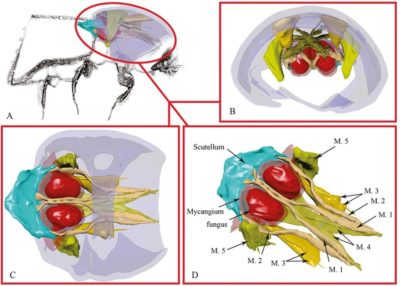
3-D imaging of the mycangia. Composite image by the Hulcr Lab.

In our constant quest to understand the anatomy and behavior of ambrosia beetles, our lab decided to experiment with 3D imaging techniques that could reveal the details of mycangia.

Mycangia are anatomical structures that most species of ambrosia beetles have in one form or another which allow them to carry samples of the fungus they depend on entirely for food from one tree host to another. They are typically complex hollows in the body of the beetle. Understanding the structures of the mycangia can help us to zero in on what species of beetle and fungi might eventually become invasive pests that threaten forests.

Entomology Today thought that our imaging experiments might be helpful to other entomologists who are considering new ways of examining tiny structures. So at their request, Dr. Jiri Hulcr (our PI) and Jackson Landers (our Strategic Science Communicator) authored an article describing our experiences. Read all about it and watch the video online.

3d, entomology today, mycangia

A new phylogenomic analysis

Posted on June 7, 2018 by jirihulcr in Uncategorized
A new phylogenomic analysis

PhD student or a Postdoc position

Posted on March 27, 2018 by jirihulcr in Uncategorized
PhD student or a Postdoc position

PRE-INVASION ASSESSMENT OF OVERSEAS WOOD BORERS

PDF HERE: Postdoc or a PhD student position

Join the Forest Entomology team (http://www.ambrosiasymbiosis.org/) at the University of Florida on our quest to discover which of the thousands of wood borer species in exotic jungles have the potential to be the next big invader into American forests. Our team includes experts in areas ranging from molecular ecology to integrative taxonomy to biosecurity regulation – are you interested in these topics? We are looking for someone who can train with us, and then master the flow of material from a foreign jungle to a DNA sequencer. Someone who will love analyzing their data, writing innovative manuscripts, and strategically posting on social media.

Do you have these TALENTS?

  • Self-sufficiency in the field
  • Quantitative thinking
  • Scientific writing
  • Patience and attention to detail

These SKILLS are not required, but will increases your chances:

  • Ecological statistics
  • Molecular biosystematics
  • Entomology, mycology or phytopathology
  • Experience with government agencies
  • Computer programming
  • Database back-end management
  • Documentary techniques, such as video, creative writing, or online science communication

Dates

Applications are due on April 10, 2018. Start: the sooner the better, ideally in the summer or fall of 2018.

Salary

Your salary, health care, and research expenses will be fully covered. For PhD students, tuition is also covered. Rates are competitive and negotiable.

Location

  1. the main campus of the University of Florida in Gainesville, FL, one of the best college towns in the US
  2. various field locations in China, Taiwan, Thailand etc.

How to apply

Email 1) your CV, 2) a short statement of interest and 3) a list of your hobbies to hulcr@ufl.edu with subject line “Pre-invasion applicant 2018”.

  • 1
  • 2
  • 3
  • 4

(c) 2013 Ambrosia Symbiosis - Web Work by Jiri Hulcr and Neil Mccoy Design