
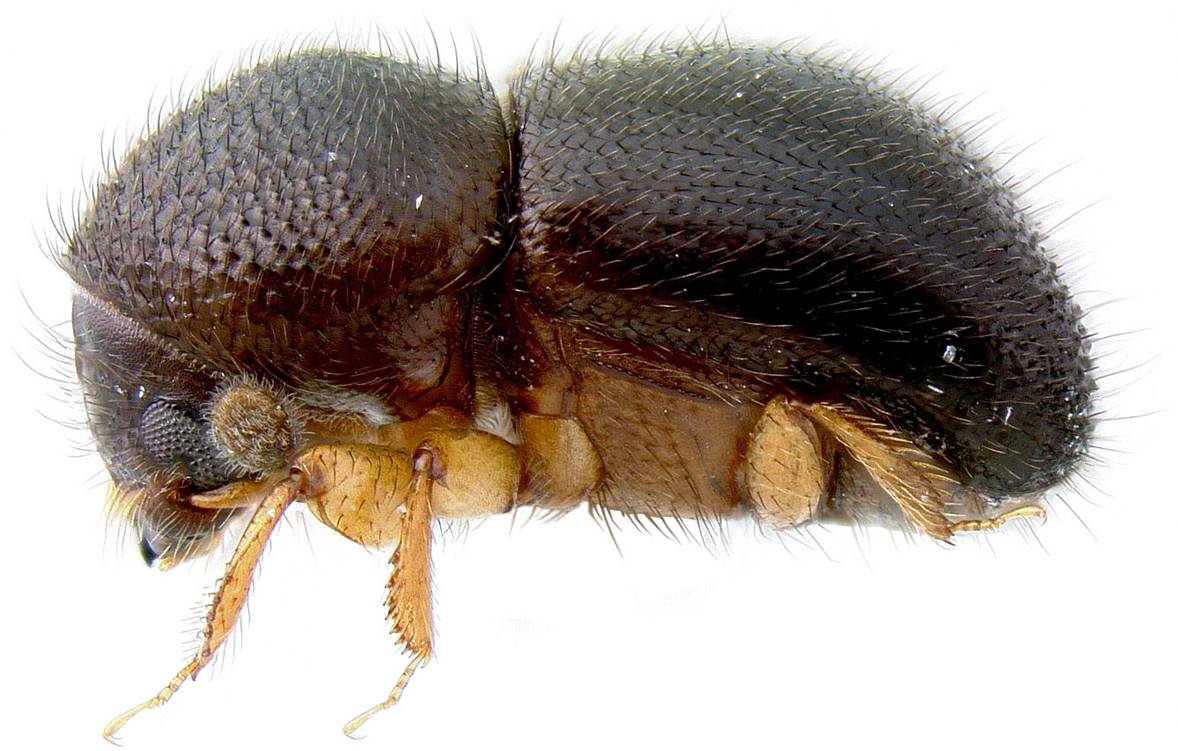
Like this bizarre Cyclorhipidion spurlinum, a newly discovered ambrosia beetle from Papua New Guinea, many insects belong to groups called “pests”, but the organisms themselves are a source of wonder to an observant entomologist.
Now in its sixth year: 2017
The purpose of the award
The award serves to promote the study of unexplored aspects of natural history of insect pests. Due to their success in the competition with humans, these insect groups are often condemned as harmful, while their remarkable qualities and peculiarities remain unnoticed. For example, only a handful of species of bark and ambrosia beetles cause damage to humans, while most of the remaining 7,500 species are fascinating organisms, cute and bizarre, living extraordinary lifestyles, and barely known to humans. The same discrepancy holds for many other insect groups. The main purpose of the award is to foster communication between fundamental and applied young entomologists, and increase their appreciation for each other’s study organisms and research methods.
The award
$500 awarded annually to a single recipient. The award is sponsored by the TREE Foundation in Sarasota, FL, and conferred by the Ambrosia Symbiosis Research Group (Jiri Hulcr and Andrea Lucky at University of Florida, Rob Dunn at North Carolina State University, and Anthony I. Cognato at Michigan State University).
Who is eligible
University students regardless of their geographic location (must be in student status at the time of submission of the competing manuscript)
Due date
Applications are due on December 31st, 2017.
Selection criteria and conditions
The selection committee will award $500 to the student who in the given year publishes the most interesting and inspiring research paper on insects which are usually regarded as pests. There are three conditions for consideration:
- the work may address any aspect of insect pest systematics, diversity, ecology, and other areas, but its main focus must not be consequences of such species to humans or pest management.
- the study must be at least “in print” in a scientific peer-reviewed journal by the annual deadline of the award,
- the applicant must be a student at the time of the application submission.
- the applicant must be the first author on the submitted paper.
Previous years
For the winner of the 2016 competition, click here.
For the winners of the 2015 competition, click here.
For the winners of the 2014 competition, click here.
For the winners of the 2013 competition, click here.
How to apply
Please send a brief e-mail to hulcr@ufl.edu containing 1) a few words about yourself, 2) a contact information of a faculty member who can confirm your student status, 3) a one-sentence summary of your discovery, and 4) the competing publication as an attachment. There are no forms to fill out.
Please send any further inquiries to hulcr@ufl.edu.
Please Donate! Your support will directly benefit the students.